How Do Innovative Surface Technologies Triple the Durability of Critical Gears
Introduction
In high-load, high-wear, and harsh environments, such as those in medical, food processing, and aerospace applications, premature failure of critical gears, as evidenced by pitting, wear, and fretting corrosion, is one of the most common reasons for increased costs of maintenance, reduced product reliability, and unscheduled downtime. The main problem with conventionally manufactured gears is the traditional approach to gear manufacturing, wherein material selection, heat treatment, and finishing processes are conducted as separate entities. However, it is to be understood that the performance of any gear is highly dependent on its surface integrity. Increasing core hardness and/or improving profile accuracy is often inadequate to resist tribo-chemical degradation and environmental degradation.
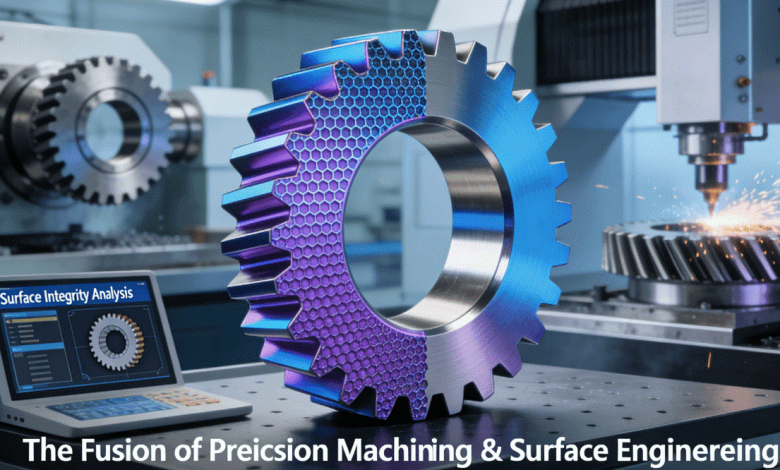
This article attempts to understand an integrated manufacturing approach wherein there is an in-depth fusion of the geometric accuracy of precision CNC machining with advanced surface engineering, such as hydrophobic coating technology. The relevant literature from authentic sources such as Fraunhofer Institute and NASA is discussed to understand how such an approach can redefine the performance limits of power transmission components.
Is the Key to a Gear’s Ultimate Lifespan the Material Itself or Its Surface?
The “material-centric” approach is the traditional view in the design of gears. However, the current consensus in modern engineering rejects the traditional view and argues that the performance of the gear in service is mainly controlled by the “functional surface system,” which is an integrated concept that includes the geometric topography, residual stresses, microstructural state, and chemical composition of the material. Cracks in fatigue or abrasive wear almost invariably begin in the surface or very near the surface.
Research by the Fraunhofer Institute for Material and Beam Technology (IWS) reinforces this point with the statement that “surface integrity determines up to 85% of a component’s dynamic load-bearing capacity and service life.” The ideal surface morphology, developed through precision CNC machining techniques such as gear grinding or honing, is the fundamental prerequisite to the success of any subsequent enhancement technique, including coating. A surface with low roughness, compressive residual stress, and no micro-cracks is the ideal canvas. Hence, a high-performance gear manufacturing process must be developed with the end surface integrity goal in mind, with every operation from blank preparation to finishing cuts being considered critical.
Is Hydrophobic Coating Technology Just About Water Repellency or a Gear’s Invisible Armor?
While words such as ‘hydrophobic’ are often synonymous with ‘water repellent’ or ‘self-cleaning,’ in the world of high-performance drive train parts, hydrophobic coating technology plays a role that is many orders more complex as an ‘invisible armor’ with many functions. The principle is to apply a nanometer-scale thin film coating with extremely low surface tension onto the gear surface via methods such as Chemical Vapor Deposition (CVD) or Physical Vapor Deposition .
This armor essentially works by inhibiting electrochemical corrosion through the repulsion of water. More importantly, the non-stick aspect greatly reduces the adhesion of impurities like grease and biofilm, which is critical in industries like medical device manufacturing. Some advanced hydrophobic coatings have low friction coefficients, providing additional wear protection. The key to success is adaptability. Different gear type profiles, like worm gears or helical gears, require tailored solutions. Leading manufacturers, like JS Precision, integrate such bespoke coating technology into their end-to-end manufacturing of gear services for demanding fields.
In Medical Device Manufacturing, What Are the Extraordinary Demands Placed on Gears?
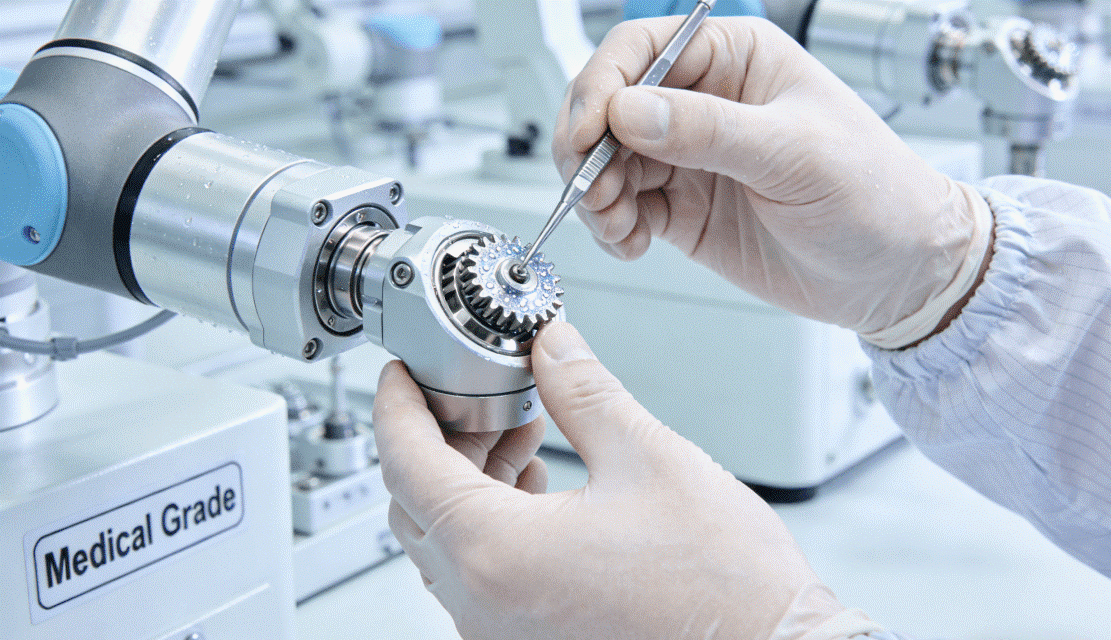
Medical device manufacturing is the apogee of requirements for reliability, cleanliness, and biocompatibility in the gear manufacturing industry. The gears inside surgical robots or MRI machines have to meet extreme conditions.
The first requirement is absolute silent reliability. The second is functioning without risk of lubricant contamination. The third is the capacity to withstand rigorous sterilization like high-temperature steam autoclaving. These present major challenges to dimensional stability and coating durability.
Meeting these demands requires a convergence of technologies in how are gears made. Material sciences offer medical-grade alloys. Precision CNC machining achieves sub-micron tolerances. Surface engineering via PVD coatings provides necessary lubricity and corrosion resistance with inert, non-toxic properties. This integrated approach represents one of the highest standards in the gear industry.
From Cutting to Coating: What is the Complete Manufacturing Journey of a High-Performance Gear?
The creation of a modern high-performance gear is a systems engineering feat integrating materials science, precision mechanics, and surface physics. The complete gear cutting and manufacturing journey is a tightly controlled sequence.
Stage One: Precision Forming and Tooth Creation
The journey begins with blank creation. The core gear cutting and manufacturing process uses hobbing or milling to create the initial tooth form. For high-precision different gears, finishing processes like grinding or honing are crucial. These precision CNC machining steps correct distortion and achieve exceptional geometric accuracy, a foundation critical for performance as highlighted in discussions on helical gear machining.
Stage Two: Imparting Core Strength
With precise geometry achieved, heat treatment builds a strong “skeleton” with a hard, wear-resistant case.
- Post-Heat Treatment Refinement
Micro-distortion from heat treatment often necessitates a light final grind or hone to restore perfect tooth geometry.
- Surface Preparation and Activation
Before coating, tooth flanks must be immaculately cleaned via ultrasonic or plasma methods to ensure optimal coating adhesion.
Stage Three: Surface Functionalization
The final step is applying a “smart skin” via advanced surface engineering, such as a DLC or hydrophobic coating, in a controlled process to create a micron-thin functional film.
What Key Certifications and Technical Capabilities Should Be Evaluated When Choosing a Gear Manufacturing Partner?
When sourcing advanced gear fabrication services, a partner’s certifications are a foundational “qualification report,” but assessing their technical integration depth is paramount.
Foundational and Industry-Specific Certifications
ISO 9001 is a basic requirement. IATF 16949 (automotive) emphasizes process control, while AS9100D (aerospace) focuses on traceability and risk management. ISO 13485 (medical devices) and ISO 14001 (environmental) are critical for their respective fields.
Technical Depth and Process Integration Prowess
Certifications are the license; technical capability is the proof. A superior supplier demonstrates mastery across the gear fabrication services value chain.
- Material and Complex Process Expertise
This includes experience with challenging materials and the ability to design unified processes that integrate machining, heat treatment, and coating.
- Metrology and Validation Capabilities
Ownership of gear measurement centers, CMMs, microscopes, and testers like salt spray chambers enables data-driven validation of performance.
From Supplier to Solutions Partner
The need is for a partner who understands the end-use application and provides a holistic solution from gear fabrication services to surface engineering, ensuring flawless in-system performance.
Conclusion
The performance frontier for gears has evolved towards a deep fusion of materials science, precision manufacturing, and surface engineering. By adopting this integrated manufacturing philosophy, engineers can create transmission components that achieve leapfrog improvements in reliability, durability, and environmental resilience, delivering decisive advantages for the end product.
Author Bio
The author is an independent consultant in the fields of precision manufacturing and surface engineering, with over two decades of experience. He specializes in providing consulting on drive solution design and manufacturing optimization for the aerospace, medical device, and high-end industrial equipment sectors.
FAQs
Q1: Will a hydrophobic coating change the dimensional accuracy of a gear?
A: High-quality coatings are very thin (micrometer-scale) and application processes like PVD are controlled, minimizing impact. However, this must be considered within the manufacturing tolerance chain.
Q2: Which industries’ gears most need this combined technology application?
A: This includes medical devices, food processing, outdoor energy, aerospace, and any scenario facing humid, corrosive, or high-cleanliness requirements.
Q3: Do surface-treated gears still require lubrication?
A: It depends on the coating design. Some hydrophobic coatings have low-friction properties. Usually, the coating protects the substrate and works with the lubrication system, not as a total replacement.
Q4: How is the service life of a surface-enhanced gear tested?
A: Besides standard bench tests, accelerated life testing simulating the real environment (e.g., salt spray) is critical. Performance is quantified by comparing treated components with untreated baselines.
Q5: Does a small-batch, high-mix production model fit well with implementation of these advanced processes?
A: Yes. Flexible manufacturing systems and modular coating equipment have made small-batch, high-performance gear production viable. The key is the manufacturer’s capability for process integration and rapid changeover.