Tech Giants Envision Future Beyond Smartphones in the AI Era
For over two decades, smartphones have been the most influential consumer technology in human history. They transformed how people communicate, work, shop, navigate cities, and consume information. Entire digital ecosystems—from social media and mobile apps to digital payments and online entertainment—were built around the smartphone. Yet today, a major shift is taking shape. Tech giants envision future beyond smartphones, signaling that the era of screen-centric computing may slowly give way to something far more immersive, intelligent, and seamless.
This vision does not suggest that smartphones will disappear overnight. Instead, leading technology companies believe the smartphone will gradually lose its position as the primary digital hub, much like desktop computers did after mobile devices became dominant. The next chapter of computing will focus on artificial intelligence, wearables, spatial computing, and ambient experiences that blend naturally into everyday life.
Why Tech Giants Envision Future Beyond Smartphones
One of the main reasons tech giants envision future beyond smartphones is market saturation. Smartphone innovation has reached a plateau. Faster processors, better cameras, and sleeker designs no longer create dramatic changes in user behavior. Global smartphone sales have stabilized, and consumers are holding on to devices longer than ever.
At the same time, users are experiencing digital fatigue. Constant notifications, endless scrolling, and screen dependency are pushing people to seek technology that supports life rather than dominates it. Tech companies see an opportunity to move beyond screens toward experiences that feel more human, intuitive, and context-aware.
The goal is clear: reduce friction between humans and technology by making computing invisible, ambient, and intelligent.
Spatial Computing: The Core of the Post-Smartphone Vision
A major pillar behind why tech giants envision future beyond smartphones is spatial computing. Spatial computing allows digital content to exist within physical space instead of being confined to flat displays. Information becomes something you see around you, not something you constantly check on a phone.
Apple popularized this idea by positioning spatial computing as the next major platform. Instead of tapping screens, users interact using eye movement, gestures, and voice. Virtual windows, 3D content, and immersive environments redefine how people work, watch media, and communicate.
In the long term, spatial computing could eliminate the need to carry a phone at all. Everyday tasks like navigation, messaging, video calls, and multitasking could take place in the space around us, seamlessly integrated with the real world.
Artificial Intelligence Replaces Apps
Another reason tech giants envision future beyond smartphones is the rise of artificial intelligence as the primary interface. The app-based model—where users manually open dozens of apps—feels inefficient in an AI-driven world.
AI assistants are evolving from simple voice tools into intelligent companions that understand context, preferences, and intent. Instead of searching for information, users will receive it automatically. Instead of switching between apps, AI will combine tasks into a single, fluid experience.
For example, rather than opening a map app, checking traffic, and messaging a colleague, an AI system could do everything at once—suggesting the best route, notifying delays, and updating schedules automatically. This shift makes the smartphone screen less essential.
Wearables as the Bridge to a Phone-Free World
Wearable technology plays a critical role in why tech giants envision future beyond smartphones. Smartwatches, fitness trackers, and wireless earbuds already handle tasks that once required phones—notifications, calls, health tracking, and voice commands.
These devices are always on the body, making them ideal for continuous interaction. Health monitoring has become one of the strongest drivers of wearable adoption, turning these devices into daily essentials rather than optional accessories.
As wearables gain more independence and processing power, they could gradually replace many smartphone functions. In the future, watches, glasses, and earbuds may communicate directly with AI systems without relying on a phone at all.
Smart Glasses and the “Eyes-Up” Experience
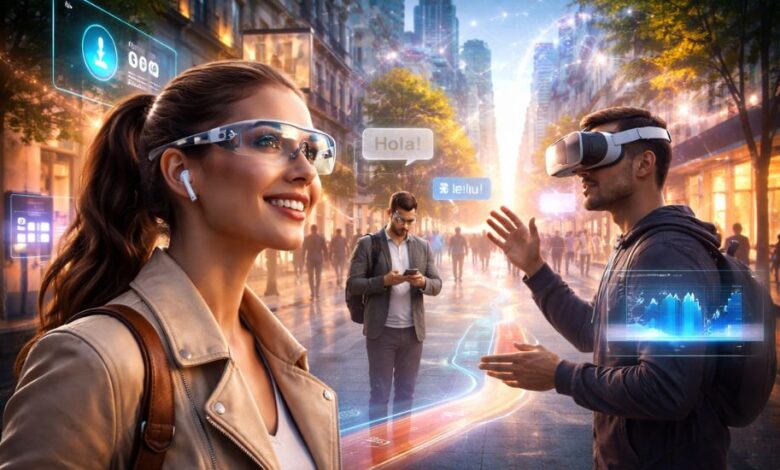
Smart glasses are central to the idea that tech giants envision future beyond smartphones. Unlike phones, which pull attention downward, smart glasses promote an “eyes-up” experience—keeping users engaged with the real world.
These devices can display directions, messages, translations, and reminders directly in the user’s field of view. Combined with AI, smart glasses can recognize objects, interpret surroundings, and provide real-time assistance.
Meta has strongly advocated this vision, investing heavily in wearable and immersive technologies. While early versions face challenges such as battery life, comfort, and privacy concerns, many experts believe smart glasses will eventually become socially accepted and widely adopted.
Virtual Reality and Immersive Environments
Virtual reality further explains why tech giants envision future beyond smartphones. While VR may not replace phones for daily tasks, it enables experiences smartphones cannot offer—fully immersive environments for work, training, education, and social interaction.
Virtual offices, collaborative design spaces, and realistic simulations are already transforming professional industries. These experiences demonstrate how computing can move beyond screens into fully digital environments that feel physical and interactive.
As hardware becomes lighter and more affordable, VR could become a common extension of everyday life, especially for work and learning.
Enterprise Adoption Comes First
History shows that many technologies gain traction in enterprise environments before reaching consumers. This pattern is another reason tech giants envision future beyond smartphones.
Industries such as healthcare, manufacturing, engineering, and education benefit greatly from hands-free access to data, immersive training, and remote collaboration. These use cases justify higher costs and help refine technology before mass adoption.
Microsoft has focused heavily on this enterprise-first strategy, using mixed reality and cloud integration to improve productivity and collaboration. Over time, these innovations are expected to transition into consumer-friendly forms.
Challenges Slowing the Transition
Despite strong momentum, challenges remain. Hardware limitations, high costs, and social acceptance are major barriers. Many people are still uncomfortable wearing visible technology in public, especially devices with cameras.
Privacy is another critical concern. Devices that continuously collect visual, audio, and biometric data raise serious questions about surveillance and data security. For tech giants, building trust will be just as important as building innovation.
Finally, smartphones remain incredibly powerful and convenient. Replacing them requires not just new technology, but a clearly superior experience.
What the Future Will Likely Look Like
Rather than a sudden replacement, the future will unfold gradually. Smartphones will coexist with AI assistants, wearables, and spatial devices. Over time, phones will become less central as other devices handle more tasks.
In this hybrid future, users may rely on smart glasses for navigation, earbuds for communication, wearables for health, and smartphones only when necessary. Eventually, the smartphone may fade into the background.
Final Thoughts
The idea that tech giants envision future beyond smartphones reflects a fundamental shift in how technology is designed and experienced. The next era of computing is not about better screens, but about smarter, more natural interactions.
As artificial intelligence, wearables, and spatial computing continue to evolve, technology will move closer to being an invisible assistant rather than a constant distraction. While smartphones will remain relevant for years, their dominance is clearly being challenged.
At Buzz Vista, we continue to explore how this transformation will shape digital life and redefine the relationship between humans and technology in a world beyond smartphones.
You may also read: Audifon: Complete Guide to Hearing Systems and Technology